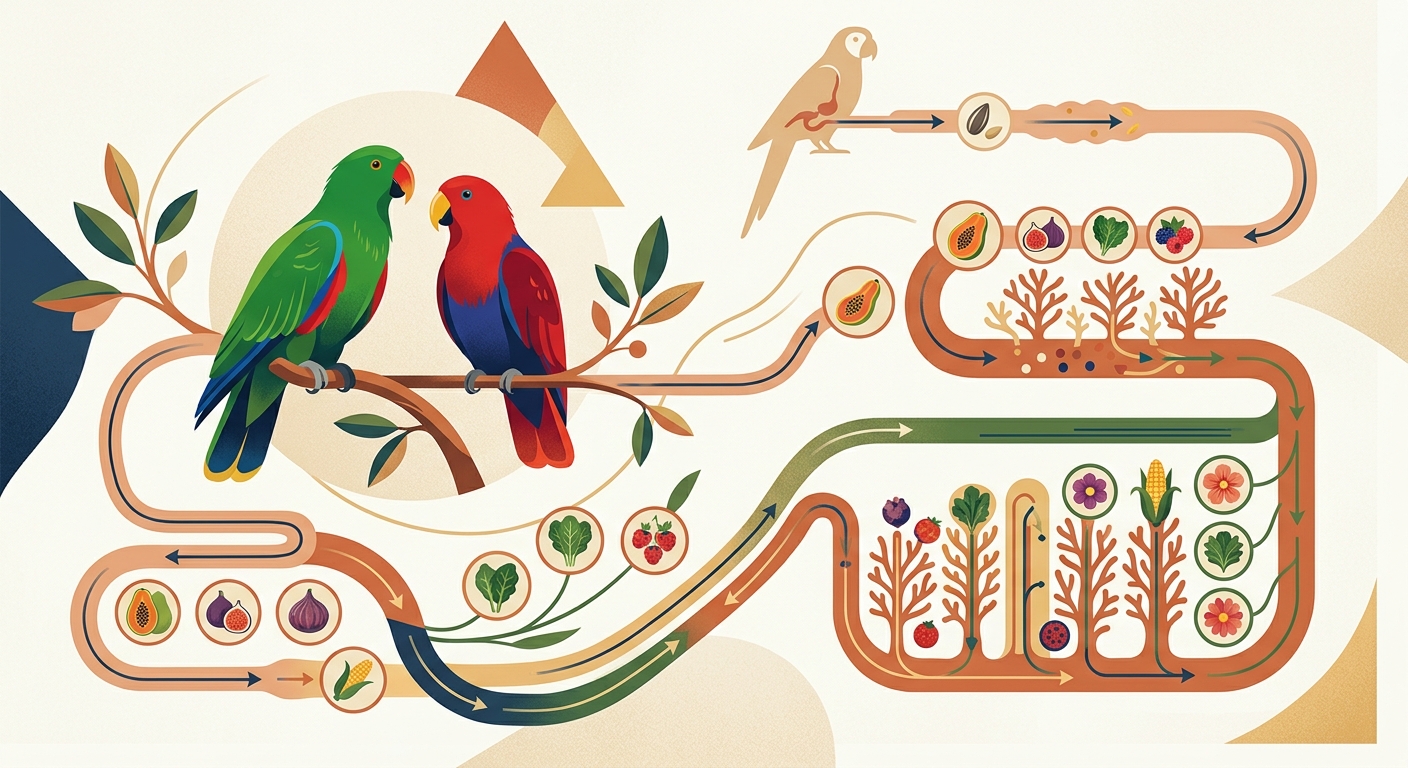
Most Eclectus arrive in a home and get fed exactly like every other parrot: a bowl of dry seed or pellets, fruit as a treat. That is where the trouble starts. Eclectus have a longer digestive tract built to pull nutrients from wet, fibrous, whole foods, not from dry, concentrated commercial mixes.
On air, professional aviculturists and long-term Eclectus keepers keep returning to the same point. Diet is not one line on this species' care checklist; it is the thing most other care questions trace back to.
Our coverage of basic parrot health care still applies as the baseline. What follows is the Eclectus layer on top of it: the digestive difference, what belongs in the bowl, what to leave out, the feather and behaviour signals that appear first, and how to move a bird already settled into the wrong routine.
The Longer Gut: Why Eclectus Digestion Changes the Rules
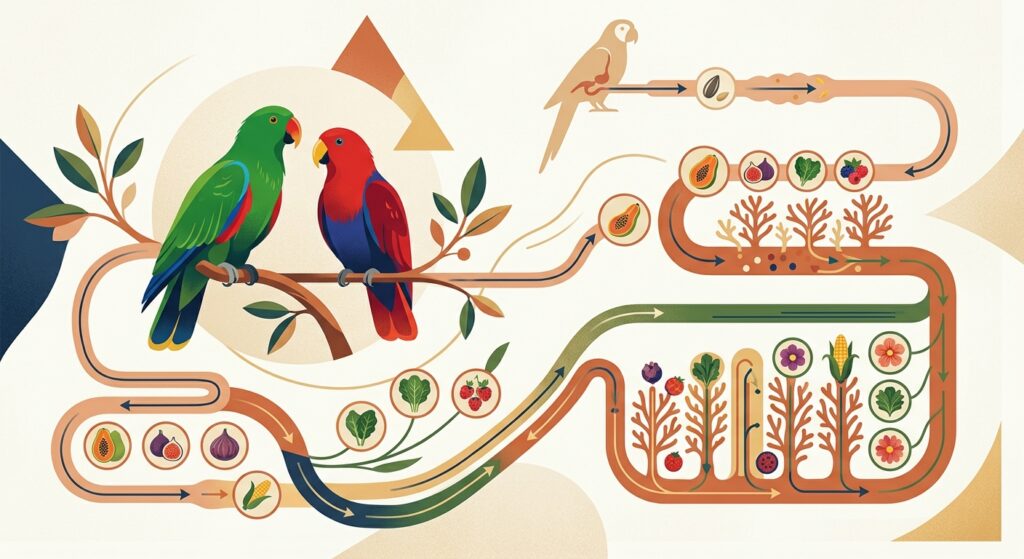
Anyone who has kept an Eclectus alongside an Amazon or a Grey notices the difference before they can explain it. The bird eats more, eats more often, and produces looser, more voluminous droppings on the same food that keeps other parrots looking tidy. That is not a health problem in itself — it is the visible end of an internal difference. The Eclectus digestive tract is longer than that of comparably sized parrots, and a longer tract changes what food is supposed to do on the way through.
What a longer tract is built to process
A longer gut buys time and surface area. That combination is useful when the food arriving is bulky, wet, and low in calories per mouthful — the kind of whole plant material a bird has to eat in volume to get enough out of it. Fibrous fruit flesh, seed pods, leaf, flower, and soft vegetable matter all move through slowly and give the gut something to work against.
Dry, concentrated food is the opposite proposition. It delivers a lot of nutrition in a small, low-moisture package, which suits a shorter tract and a smaller meal. Put it through a system designed for wet bulk and the arithmetic stops matching: the bird meets its calorie needs long before it has eaten enough physical volume, and the tract is left processing a load it was not shaped around.
| Dimension | Wet, high-fibre whole plant food | Dry concentrated food |
|---|---|---|
| Moisture | High, contributes to daily water intake | Low, water must come separately |
| Calories per mouthful | Low | High |
| Volume the bird must eat | Large, across the day | Small, quickly finished |
| Fibre load | Substantial | Usually modest |
| Time in the gut | Slower, suits a longer tract | Faster than the tract expects |
What this means day to day
The practical consequences come up again and again when we put Eclectus keepers and breeders on air:
- Volume matters as much as content. An Eclectus that has finished eating in ten minutes has probably not eaten enough bulk, even if the nutrition label says otherwise.
- Moisture is part of the meal. Water in food is not a garnish for this species; it is how the diet is meant to arrive.
- Droppings read differently. Wetter, larger droppings on a wet, fibrous diet are not automatically a warning sign — but a sudden change in them is.
- Grazing beats set meals. Food available across the day fits a gut built for a steady, slow passage rather than two concentrated feeds.
- Fillers are not free. Because these birds eat by volume, whatever fills that volume gets eaten in quantity — including anything you would rather they had only a little of.
None of this makes the Eclectus fragile. It makes it specific. The bird is doing exactly what its anatomy suits it to do, and most of the trouble keepers report starts with a diet that assumes the anatomy is standard.
Feed the Eclectus for the length of its gut, not for the label on the bag — the same food that keeps another parrot in good order can pass through this species as an ill-matched load.
What Goes in the Bowl: Fresh Produce and Sprouted Seed
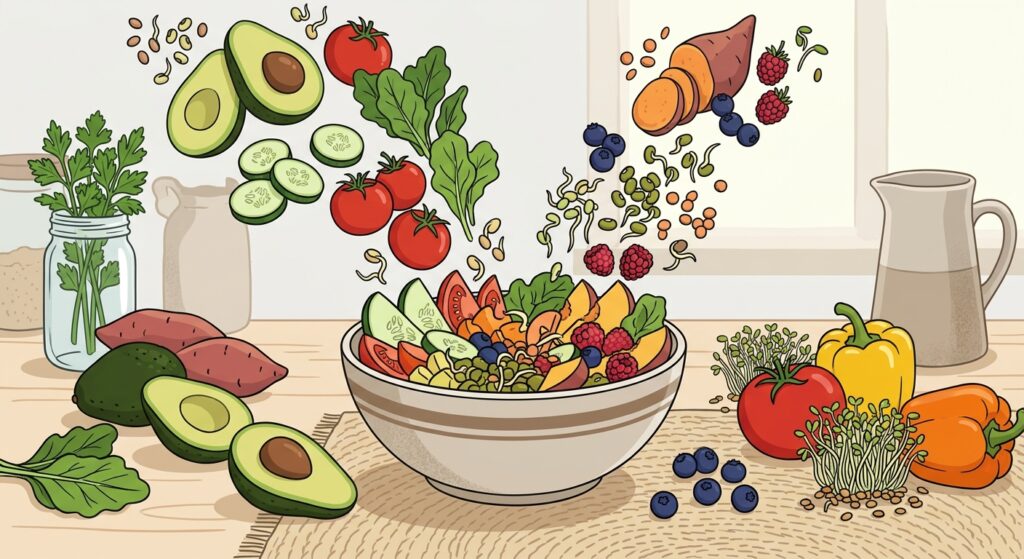
A working Eclectus diet looks less like a parrot bowl and more like a salad. The bulk of what goes in should be fresh produce, with sprouted seed and a smaller measured portion of pellet or dry seed rounding it out rather than forming the base. Guests on our show who keep Eclectus long term describe the same pattern again and again: the birds do best when the majority of the daily intake is wet, fibrous and freshly prepared.
Building the Bowl Around Produce
Aim for variety across the week rather than perfection in a single bowl. A practical rotation includes:
- Orange and dark green vegetables — carrot, sweet potato, butternut, kale, broccoli, dark leafy greens. These carry beta-carotene in its natural form, which is the route many Eclectus keepers prefer over heavily supplemented feeds.
- Fresh fruit — papaya, mango, pomegranate, figs, apple, berries. Fruit is not a treat category for this species the way it is for some others; it belongs in the daily bowl.
- Cooked or soaked legumes and whole grains — chickpeas, lentils, quinoa, brown rice, in modest amounts for bulk and slow-release energy.
- Sprouted seed and pulses — the living component, covered below.
- Fresh browse — untreated branches, leaves and edible flowers where you can source them safely.
Chop coarsely rather than finely. Eclectus use their feet and beak to work through food, and pieces they can hold get eaten more reliably than mush.
What Sprouting Does to Seed
Dry seed is a storage organ. Its job is to hold concentrated fat and starch until conditions are right to grow. Once you soak and germinate it, the seed switches from storing to building — moisture floods in, enzymes activate, and the fat and starch reserves start being consumed by the emerging plant. What you hand the bird is no longer a fat-dense concentrate but a living, high-moisture, high-fibre vegetable.
| Dry seed | Soaked seed | Sprouted seed | |
|---|---|---|---|
| Moisture | Very low | High | High |
| Fat density per gram | Highest | Reduced by water weight | Lowest of the three |
| Fibre character | Hull only | Hull, softened | Hull plus growing shoot |
| Prep time | None | 8–12 hours soaking | 1–3 days, rinsed twice daily |
| Safe time in the cage | All day | A few hours | A few hours |
Rinse thoroughughly at every stage, discard anything that smells sour or slimy, and never let a sprout batch sit warm and unwashed.
Getting a Bird to Actually Eat Wet Food
Refusal is usually about presentation, not preference.
- Serve the wet bowl first thing in the morning, before any dry food goes in.
- Put it in a shallow, wide dish the bird can see into and stand beside.
- Keep colour contrast high — bright produce against a plain bowl.
- Eat some yourself, visibly. Flock feeding converts stubborn birds faster than any trick.
- Remove wet food after a few hours and replace it fresh rather than topping it up.
Wet food spoils fast, so a bowl left in a warm cage all day becomes a bacterial risk rather than a nutritional win — pull it and replace it rather than letting it sit.
Artificial Dyes, Fat and the Case Against the Standard Seed Mix
The Dye Question Comes Up in Almost Every Interview
Ask an Eclectus keeper on air what they removed first and the answer is almost always the same: anything artificially coloured. Rainbow-coloured pellets, tinted treat sticks, dyed seed-and-fruit "gourmet" blends. The reasoning we hear repeated is consistent — keepers describe behavioural changes they associate with coloured feed, most often toe-tapping and wing-flipping, and they describe those signs easing after switching to an uncoloured diet.
We want to be honest about what that is: it is observation, not proof of mechanism. But it is observation from a lot of independent people who did not compare notes first, including breeders working with multiple birds over many years. When several unconnected aviculturists arrive at the same rule, it is worth acting on, particularly when the cost of acting is nothing. No Eclectus needs a green pellet. The colour is for the person buying the bag.
The same caution extends to artificial preservatives and flavourings in treat products. Given a digestive tract built to strip nutrition out of soft plant matter over a longer transit time, guests argue there is simply more contact time with whatever additives are in the food — and no reason to run the experiment.
Why the Standard Seed Mix Is the Wrong Default
Dry seed mixes are sold as the baseline parrot diet, and for an Eclectus they are close to the opposite of what the gut is set up for. They are dry where the bird evolved on wet, fibre-poor where it evolved on bulk, and calorie-dense where it evolved on volume.
| What ends up in the bowl | Why it gets bought | What keepers report on air |
|---|---|---|
| Sunflower and safflower-heavy mixes | Cheap, birds eat it eagerly | Selective feeding, weight gain, refusal of fresh food |
| Peanuts and other nuts, offered daily | Used as a bonding treat | Fat load with no fibre; better kept as an occasional reward |
| Coloured "fruit" treat sticks | Marketed as enrichment | Sugar and dye with little nutritional return |
| Human snack foods and crackers | Shared at the table | Salt, oil and refined flour the gut is not built to process |
| Dried fruit with added sugar or sulphites | Convenient, shelf-stable | Concentrated sugar; fresh or rehydrated is preferred |
The Convenience Trap
The practical problem with high-fat dry food is not one bad meal — it is that a bird filling up on sunflower seed has no appetite left for the vegetables and sprouted seed that should be doing the work. Keepers describe the same pattern:
- The bird picks the fat out and leaves the rest.
- Fresh produce sits untouched and gets binned.
- The owner concludes the bird "doesn't like vegetables" and buys more seed.
Breaking that loop usually means removing the easy calories first and accepting a period where the bird complains, rather than trying to add fresh food alongside an unlimited seed dish.
If you change only one thing after reading this, take the artificially coloured food out of the cage — it is the single adjustment the most Eclectus keepers have credited with a visible difference on air.
Reading the Feathers: What Diet Problems Look Like Before They Look Like Illness
The Feather Record Runs Weeks Behind the Bowl
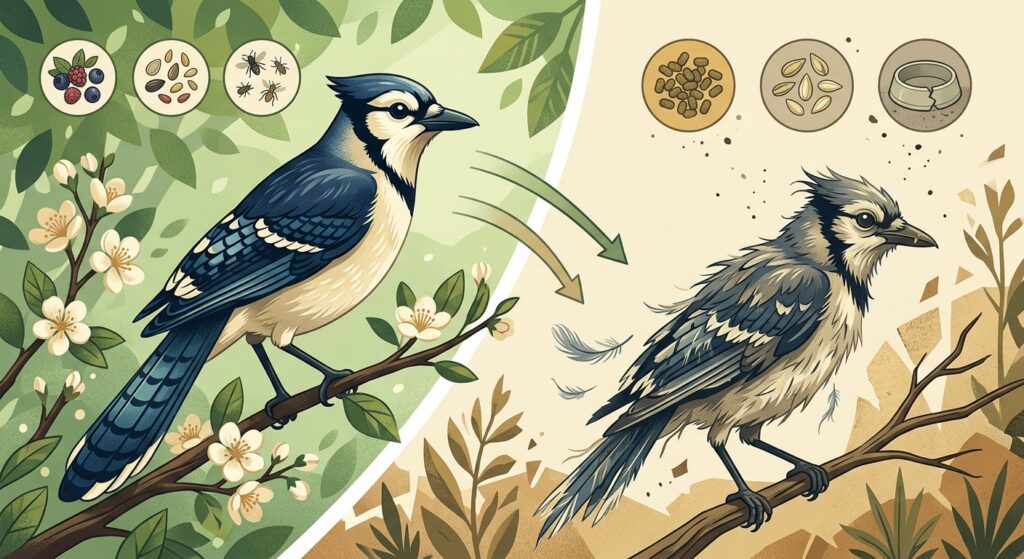
A feather is grown once and then carries whatever the bird had available at the time it was formed. That makes plumage a slow, honest record of the previous weeks and months rather than a report on this morning's breakfast. Guests on air who breed and keep Eclectus describe the same handful of markers again and again:
- Black or dark tipping and barring appearing on green wing feathers in hens and cocks
- Orange, yellow or red feathers erupting through areas that should be solid green
- Dull, chalky colour where the plumage was previously deep and saturated
- Stress bars — fine lines running across the vane of a growing feather
- Ragged edges, poor sheath release and feathers that look thin or wispy
None of these prove a single cause on their own. What they do tell you is that something was wrong while that feather was growing, and because Eclectus feathers are replaced gradually, the correction you make today will not show in the mirror for a long time. Keepers who expect a fast visual payoff often abandon a good diet change too early.
Behaviour and Droppings Move Much Faster
Where feathers lag, behaviour and droppings respond within days. This is the layer worth watching most closely, because it is where a diet problem is still cheap to fix.
| What you notice | What it often points toward | How quickly to act |
|---|---|---|
| Toe tapping or wing flicking | Frequently linked by keepers to fortified pellets, supplements or additives in the diet | Review everything fed in the last week |
| Droppings suddenly very wet | Often high water content produce — usually harmless if the bird is bright | Watch 48 hours, note the pattern |
| Dark, scant or unformed droppings | Reduced intake, or the bird is eating less than you think | Same day attention |
| Selective feeding, bowl picked over | Produce variety too narrow, or the bird has learned to hold out for a favourite | Adjust presentation, keep offering |
| Weight dropping on the scale | Insufficient calories reaching a long gut | Same day attention |
A gram scale used at the same time each morning is the single most useful piece of equipment here. It catches a decline long before the bird looks unwell, which matters with a species that will keep behaving normally while losing condition.
When It Stops Being a Diet Question
Our general guidance on warning signs in pet birds applies fully to Eclectus, and nothing in their unusual digestion changes those thresholds. Fluffed sitting on the cage floor, tail bobbing with each breath, discharge from nares or eyes, vomiting, blood in droppings, or a bird that suddenly goes quiet all mean an avian vet appointment, not another week of adjusting the salad.
The same is true of feather destruction. Chewing, plucking and barbering may well have a nutritional component, but they also accompany pain, skin disease and parasites. Rule out illness first, then work on the bowl.
Treat feather colour as a record of the past and droppings, weight and behaviour as the report on today — and never spend a fortnight tinkering with produce while a bird is showing the signs that call for an avian vet.
Switching an Eclectus Off a Dry Diet Without Losing Weight
Start With the Scale, Not the Bowl
Before you change a single thing about what goes in the dish, get a baseline. A digital kitchen scale that reads in single grams, a perch or a small towel on the platform, and a notebook are all you need. Weigh at the same time each day — first thing in the morning, before the first feed, is the most consistent — and log the number for a week while the bird is still on its familiar diet. Without that baseline, you have no way of knowing whether a 12-gram drop three weeks in is a problem or just the difference between a full and an empty crop.
Also log what actually gets eaten, not what gets offered. Eclectus are skilled at shredding food and dropping it, and a bowl that looks worked-over can belong to a bird that has swallowed very little.
A Staged Conversion That Doesn't Gamble With Weight
The birds we hear about on air that convert well are almost always the ones whose keepers moved in small, boring steps.
- Week one — proximity only. Put a second bowl of fresh food in the cage alongside the usual dry diet, unchanged in quantity. The bird eats what it always eats and gets used to the sight and smell of the new food.
- Week two — familiarity. Keep offering fresh alongside, but present it in the shapes and textures the bird already trusts: long strips it can hold, warm rather than fridge-cold, chopped fine and mixed into a tiny amount of the dry food it already accepts.
- Week three — timing. Offer fresh food first thing in the morning, when appetite is highest, and hold the dry diet back until mid-morning. Do not remove it; just delay it.
- Week four onward — gradual reduction. Once you can see fresh food genuinely being consumed, begin trimming the dry portion in small increments, holding each reduction for several days and watching the scale before the next one.
- Plateau if needed. If weight stalls or drops, go back to the previous step and stay there. There is no prize for finishing fast.
Reading the Signals Day to Day
| What you see | What it usually means | What to do |
|---|---|---|
| Weight steady, droppings wetter and looser in colour | Normal response to higher water content in food | Continue as planned |
| Weight steady, fresh food untouched | Bird is filling up on dry diet | Reduce dry portion slightly, not fresh |
| Weight down three days running | Bird is not replacing the calories you removed | Restore the previous dry ration immediately |
| Sudden loss of interest in all food, quiet or fluffed | Not a diet-conversion issue | Stop the transition and call an avian vet |
Abrupt substitution — pulling the seed dish and hoping hunger does the teaching — is the single most common way keepers turn a healthy bird into a thin one. A parrot's fat reserves are small, and a bird that goes off food entirely deteriorates in days, not weeks.
Never remove a food your Eclectus is actually eating until you have watched it eat the replacement and confirmed on the scale that its weight is holding.
Leave a Reply