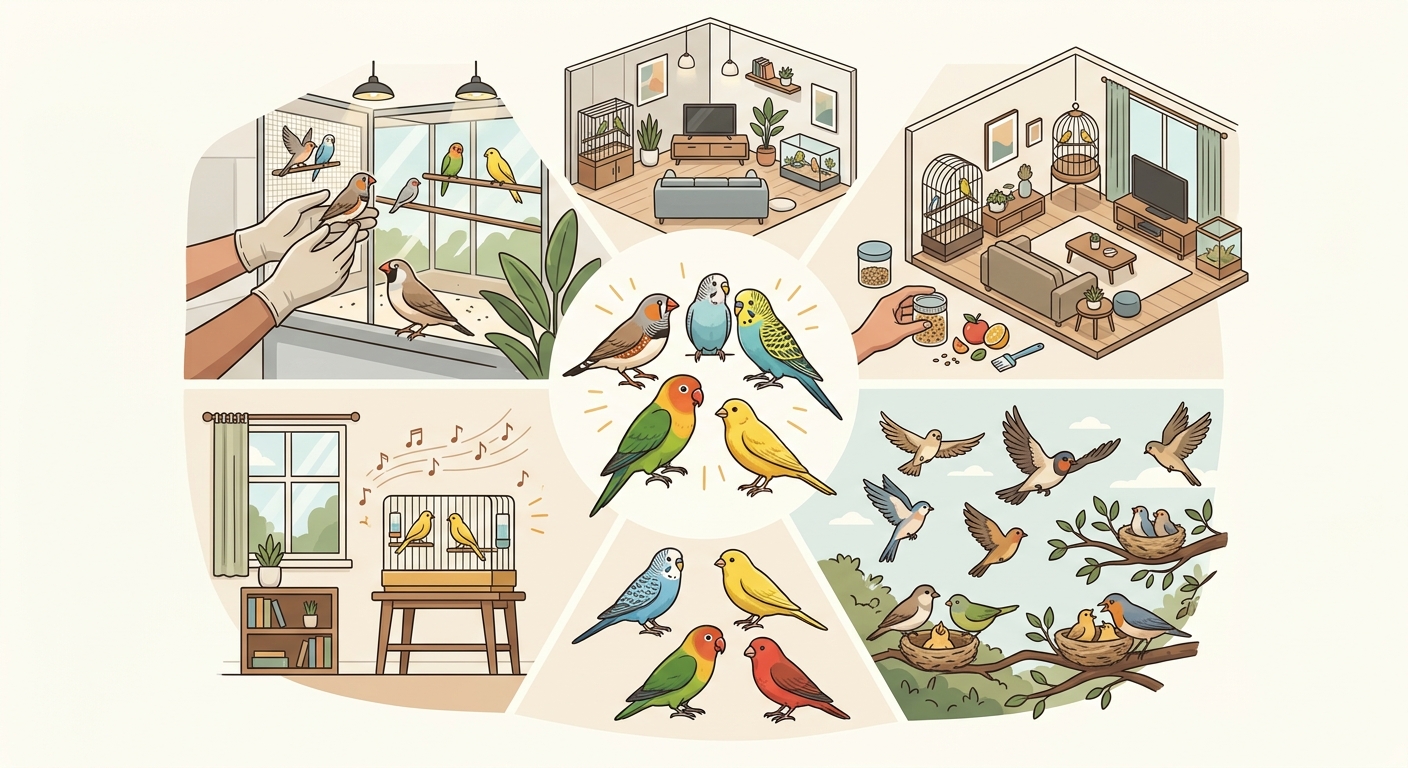
Buy a budgie or a pair of finches and you will hear the same thing from somewhere: it's a good bird to start on. Then, later, you'll get a real parrot. That framing causes real harm, because it tells you the bird in front of you needs less thought than it does.
The aviculturists and long-time keepers we interview live on air don't talk that way. Many keep budgies, cockatiels, canaries and finches alongside their larger parrots — or instead of them — and discuss them with exactly the same seriousness.
This article gathers what those guests keep returning to. General feeding, health and warning signs are covered in our existing keeping and health articles, so here we stay on what is specific to the small-bird end of aviculture.
Why Aviculturists Keep Small Birds When They Could Keep Anything
One of the recurring surprises for listeners new to our shows is how many long-standing aviculturists keep budgerigars, cockatiels, canaries and finches by choice — not because a larger parrot was out of reach, but because these species offer things a single macaw cannot.
Breeding is the reason we hear most often. Small birds mature quickly, produce multiple clutches in a season, and let a keeper actually work with genetics, pairings and record-keeping across generations. That's a different hobby from managing one long-lived companion parrot, and it attracts people who want to study a species rather than simply live with an individual.
Flock behaviour comes a close second. A well-set-up aviary or bird room shows courtship, territorial disputes, allopreening, feeding hierarchies and juvenile learning — the ordinary social life of a species — in a way a solitary bird in a living room never will. Guests who keep finches in particular talk about spending as much time watching as handling.
Then there is song and colour. Canary keepers describe song as the whole point, developed and judged with real seriousness. Budgerigar and finch keepers talk about colour varieties and form with the same precision.
Space and lifespan realism matter too, and experienced keepers say so plainly on air. Small birds fit homes and flights that most people can genuinely provide, and their lifespans are commitments a keeper can honestly plan for rather than write into a will. Choosing within your space and your means is not a compromise in aviculture — it is competence.
Parakeet or Finch: Two Completely Different Kinds of Bird to Live With
The word "small bird" flattens a real difference. A budgie is a parrot. So is a cockatiel. They have hooked bills built to crack, strip and dismantle, feet that grip and climb, and the social wiring that comes with being a flock animal capable of forming attachments outside its own species. Guests on our shows who keep budgies describe birds that learn names, mimic household sounds, work out how a cage latch functions, and grow bored in a way that shows up as feather damage or screaming when there is nothing to take apart.
Finches are a different proposition entirely. Zebra finches, society finches, Gouldians and the softbills kept alongside them are birds you house and observe rather than birds you handle. They pair up, they sing to each other, they build and squabble over nest sites, and they generally treat human hands as a threat rather than a perch. Catching one is something you do for a health check or a move, not for company. That is not a lesser relationship — several keepers we have interviewed find an aviary of finches more absorbing than a single tame bird, precisely because the behaviour on show is bird-to-bird rather than bird-to-owner.
The practical consequences follow from that split:
- Hookbills need destructible enrichment, out-of-cage time or a large flight, and daily interaction from someone in the household.
- Finches need horizontal flight space, appropriate company of their own kind, and to be left alone to get on with it.
Choosing between them is choosing which of those commitments you actually want.
The Cage Question: Length Matters More Than Height for Small Birds
Ask a guest on air what cage they would buy if they could only buy one, and the answer almost never starts with a number. It starts with a direction. Budgerigars and finches are horizontal fliers. They cross a space, land, turn, and cross it again. A tall, narrow cage gives them a column of air they will rarely use, because neither species climbs the way a parrot with a strong beak-and-foot grip does. A budgie will work the bars sideways if it has to, but that is compensation, not natural movement.
The practical rule we hear repeated by keepers who have kept both species for years: buy the longest cage that will fit the space you have, then worry about everything else. Length is the dimension the bird actually spends.
That single decision changes several others:
- Perch placement. Perches at either end of a long cage create a flight path. Perches stacked up the middle of a tall cage create a ladder and nothing more.
- Clutter. Toys, dishes, and swings hung across the middle of a short cage remove the only flight line the bird had. In a longer cage, furnishings can sit at the ends.
- Finch density. Finches live socially and move constantly. Length is what lets a pair or a group avoid each other, which matters more than most first-time keepers expect.
Bar spacing is the other non-negotiable, and it differs between the two species — a gap that safely contains a budgie can trap a finch's head.
Flock Size: Why One Budgie, Two Finches and Six Canaries Are All Different Problems
A single budgie kept alone is a bird whose entire flock is you. Keepers who go that route need to be honest about the time it demands: a lone budgie left with an empty room for ten hours a day is not a low-maintenance pet, it is an under-stimulated one. The keepers we speak to who do this well tend to have the cage in a room the household actually uses, and they build the bird's day around routine contact — talking while they work, out-of-cage time at the same hours, hands-on handling that keeps the bird comfortable being touched and towelled.
A bonded pair is a different arrangement altogether. Two budgies, or two finches, will usually direct their social attention at each other rather than at the person on the other side of the bars. That is not a failure — for a great many keepers it is the kinder setup, and finches in particular are birds to be watched rather than handled. But expect a pair to be less interested in stepping onto a finger, and don't be surprised if a hand entering the cage is treated as an intrusion.
Colonies raise a third set of questions, and they are questions about compatibility rather than numbers. Six canaries is not one problem repeated six times. Things to watch:
- Males competing over territory or nesting sites
- Mixing species with very different temperaments in one flight
- A single bird being pushed off food, water or perches
- Breeding condition, which changes behaviour in otherwise settled birds
Aggression in a colony is usually visible before it is serious. Watch daily.
Seed Is Not a Diet: What Small-Bird Keepers Feed Instead
The single most repeated correction we hear from guests on air is that a seed dish is not a diet. Wild budgerigars and finches eat seed, but they eat it at different stages of ripeness, alongside greens, seeding grass heads and whatever else the season offers. A bowl of dry packaged seed, topped up daily, is a narrow version of that — and the birds will eat the sunflower-rich or millet-rich bits first and leave the rest.
What keepers describe moving toward tends to look like this:
- A formulated pellet as the base, introduced slowly, because small birds are conservative eaters and will often refuse an unfamiliar food rather than try it.
- Fresh greens and vegetables offered daily, in quantities small enough to remove before they spoil.
- Sprouted or soaked seed, which several guests treat as the bridge food — it is recognisably seed to the bird, but nutritionally closer to living plant material.
- Millet spray used as a training and enrichment item rather than a staple.
Two persistent myths come up. Grit is not required by birds that hull their seed, and keepers have described birds harmed by free access to it. Calcium, by contrast, is genuinely needed — cuttlebone or a mineral block, and closer attention for hens in breeding condition.
Small birds run hot. A budgie or finch off its food is in trouble in hours, not days, so dietary gaps show up fast. Our practical feeding plan sets out the fuller framework.
Small Birds Hide Illness Faster Than You Can Notice It
A budgie or a zebra finch is prey. Everything in its wiring says that a bird visibly struggling is a bird that gets picked off, so it holds its posture, keeps eating in front of you, and stays on the perch until it cannot. By the time a small bird looks sick, it has usually been sick for a while. Add the second problem: there is very little body to work with. A bird weighing in the tens of grams has almost no reserve, so a couple of days off food or a mild infection can move from "seems a bit quiet" to a genuine emergency inside a single evening.
Keepers who come on air describe the same short list of things they check, and they check it without waiting for a reason:
- Weight — the earliest and most honest signal, because it drops before behaviour changes.
- Droppings — colour, water content, and whether the volume matches what the bird has eaten.
- Tail bob — a rhythmic pump with each breath is respiratory effort, not relaxation.
- Perching low — a bird that abandons the high perch is conserving energy.
- Fluffed posture — especially fluffed and sleeping in daylight, on two feet rather than one.
The single most useful habit our guests recommend is a weekly reading on a gram scale, taken at the same time of day and written down. A bird that is 34 grams every Sunday and 31 grams this Sunday has told you something no amount of looking at it would have.
Breeding Budgies, Canaries and Finches: What Guests Warn Newcomers About
The breeders who come on air are usually the ones most cautious about encouraging breeding. Their first warning is almost always about hens. A budgie or canary hen who starts laying and cannot be persuaded to stop will keep producing clutch after clutch, drawing calcium out of her own skeleton to make shells. Guests describe the results plainly: soft-shelled eggs, egg binding, weakened bone, a hen who is thinner every time you pick her up. This happens in pet homes with no male bird present, because laying does not require one.
What triggers it is usually environmental, and that is the part newcomers control. Guests point to the same list repeatedly: anything cave-like or enclosed that a hen can sit inside, long daylight hours, unlimited soft food and constant access to a favoured human or mirror as a pair-bond substitute. Remove the nest site, shorten the day, cut back the rich food, and most hens stop. Keepers who leave a "cosy" hut in the cage are often unknowingly asking for eggs.
The second warning concerns what happens if eggs hatch. Finches and budgies produce young in quantity, and every one of those birds needs a home that will keep it properly for years. Our guests who breed deliberately do it with a plan — a reason for the pairing, records, buyers or aviary space arranged before the first egg. Accidental breeding has none of that, and the birds produced are the ones that end up passed along repeatedly. The difference is not the biology. It is the preparation behind it.
Taming, Talking and Training a Bird That Fits in Your Hand
A budgie is a hookbill, and that means the same training vocabulary used on macaws and greys applies — scaled down. The bird is small enough that a nervous keeper can be tempted to grab rather than ask, and grabbing is what sets progress back weeks.
Start with a target. A millet spray or a chopstick the bird touches with its beak for a reward gives you a way to move a budgie around the cage, onto a perch, or off a curtain rod without hands. It builds the habit of the bird choosing to come to you.
Then step-up. Present a steady finger just above the feet, ask, and pay the bird when it steps. Keep sessions to a few minutes. Small birds fatigue and lose interest quickly, and a bored budgie is harder to win back than a shy one.
Recall belongs in a prepared room. Windows covered, ceiling fans off, other pets shut out, water bowls and toilet lids closed, cooking finished. Two people calling a bird back and forth across a small room builds flight fitness and confidence at the same time.
Speech is a budgie possibility, not a guarantee. Single birds housed close to household conversation tend to pick up more words than birds absorbed in a companion, and males more often than hens. Repetition of short phrases in the same tone, at the same time of day, is what keepers on air credit most.
Finches are a different proposition entirely. You train their environment — perch placement, feeding routine, your own quiet predictability — and let them decide how close they sit.
Hazards Scaled Down: Why the Same Household Risks Hit Small Birds Harder
A budgie or a zebra finch carries a fraction of the body weight of a macaw, and everything that enters its body is measured against that weight. The same puff of aerosol, the same fumes drifting from a kitchen, the same brief chill arrive as a far larger dose relative to the bird. This is the point our guests return to most often when newcomers ask why small birds "suddenly" die: the exposure was not sudden, it was simply small enough that nobody thought it counted.
The recurring household hazards worth treating as absolute rules:
- Overheated non-stick cookware. PTFE coatings release fumes when a pan is left dry on heat. Birds have no margin here, and small birds have less than most. Keep birds out of the kitchen and ventilate it.
- Aerosols and airborne scents. Sprays, air fresheners, scented candles and cleaning products all put particles into shared air. A bird weighing tens of grams breathes that air continuously.
- Drafts and temperature swings. A cage beside a frequently opened door, an air conditioning vent or a single-glazed window subjects a small body to repeated stress it cannot buffer.
- Cats. Bacteria in cat saliva can turn a puncture too small to see into a fatal infection. Any contact, however brief, needs veterinary attention immediately.
- Open windows and doors. Finches bolt when startled; budgies fly the moment a cage door is left ajar. Escapes almost always happen during routine cleaning or feeding, not during anything dramatic.
What We Hear on Air: Recurring Themes From Small-Bird Keepers
Across years of live conversations, the same handful of themes surface no matter whether we are talking to a professional breeder, a rescue volunteer or someone who bought their first budgie a month ago.
- Underestimation comes first. Callers frequently describe buying a small bird as a starter pet and discovering, sometimes years in, how much space, company and observation it actually asks for.
- Species-specific thinking arrives late. Guests keep returning to the point that "small bird" is not a category you can keep. Budgies, canaries and the various finches want different housing, different social arrangements and different handling.
- Diet is where most keepers change their minds. The move away from a seed-only bowl is the single most common "I wish I'd known sooner" moment we hear on air.
- Illness stories are told in hours, not weeks. The professionals push hardest on this, and the keepers who have lost a bird tend to agree with them without argument.
- The keepers who do best watch closely. Weight, droppings, posture, noise level, who is bullying whom at the seed dish — attentiveness comes up more often than equipment does.
If you keep parakeets, canaries or finches, we would rather hear your version of these patterns than summarise them ourselves. Bring your setup, your feeding routine, your breeding season that went sideways, or the question you have never had answered properly. Join us live on Bird Talk Radio and put it to our guests directly, or catch the episode later on the podcast if the schedule does not suit.
Leave a Reply