Ask a room of parrot people about wild caught birds and you will get an argument. Ask twice and you may get two arguments. The phrase still comes up constantly among owners, aviculturists, and avian veterinarians, and it lands differently than "captive-bred" — heavier, and usually with a moral edge attached.
The distinction itself is simple. A wild caught parrot was trapped in its native range and moved into captivity. A captive-bred parrot hatched in captivity, often hand-raised from the nest.
In years of producing and hosting Bird Talk Radio, this remains one of the subjects our listeners return to and refuse to agree on. Below we lay out both sides, the welfare and behavioral realities, and what responsible keeping looks like now — without pretending the question is closed.
What 'Wild Caught' Actually Means, and How It Differs From Captive-Bred
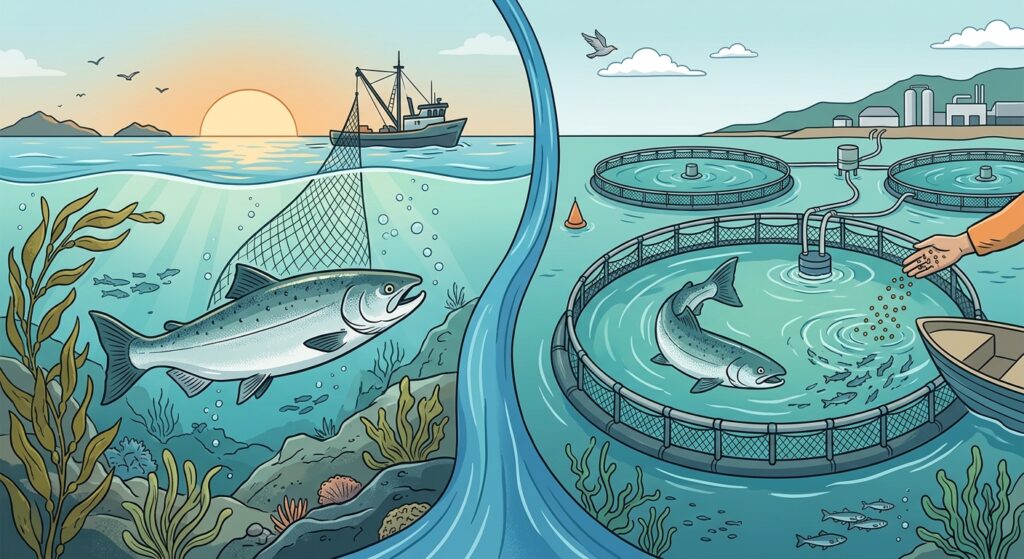
A wild caught parrot hatched in the wild, fledged in the wild, and was trapped as a juvenile or adult before entering the pet trade. A captive-bred parrot hatched from parents held in captivity — sometimes parent-raised in an aviary, sometimes pulled for hand-feeding. "Domestically raised" usually means captive-bred and hand-reared in a home or breeder setting, socialized to people from the start.
Those three paths produce very different birds:
- Wild caught — learned foraging, flock language, and predator wariness from wild parents. Humans were never part of the equation.
- Captive-bred, parent-raised — raised by parrot parents in an aviary; often better-adjusted as a bird, but less accustomed to handling.
- Captive-bred, hand-raised — imprinted on human caregivers, comfortable with handling, but sometimes lacking normal parrot social skills.
| Wild caught | Captive-bred, parent-raised | Hand-raised | |
|---|---|---|---|
| Early social model | Wild flock | Captive parents | Humans |
| Typical response to handling | Avoidance, flight, defensive biting | Cautious, learns with time | Solicits contact |
| Provenance record | Often incomplete | Usually traceable to breeder | Usually traceable to breeder |
| Adjustment period | Long, sometimes lifelong | Moderate | Short |
The trouble is that the label does a lot less work than buyers assume. A bird described as "captive-bred" may still be an unpapered import. An older bird resold several times may carry no reliable history at all. And a captive-bred bird raised in a crowded, hands-off setting can behave much like a wild caught one — flighty, untouchable, mistrustful — while a long-settled wild caught bird may be calmer than either. Band numbers, hatch records, and breeder contact details tell you more than any word on a cage tag.
Ask for written provenance — band, hatch date, and breeder — before you accept any seller's description of a parrot's origin.
The Case Against Taking Parrots From the Wild
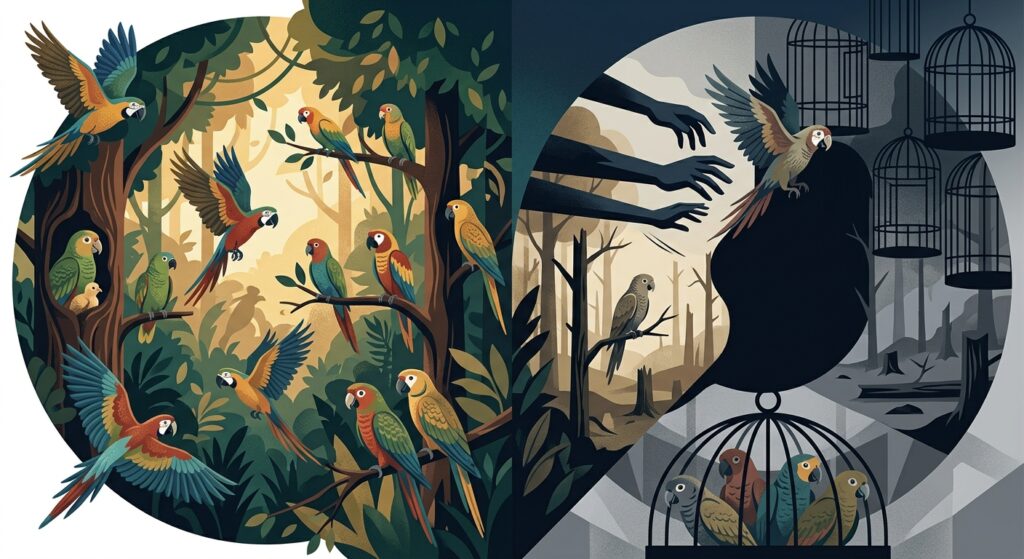
The objections we hear most often from conservation-minded aviculturists and avian veterinarians on our shows tend to cluster around four points:
- Pressure on wild populations. Every bird removed is a breeding adult or future breeder taken out of a population that may already be under pressure from habitat loss. Trapping targets the same accessible, desirable species repeatedly, and local populations can thin out long before anyone notices at a national level.
- Losses in capture and transport. Birds are not simply moved from a tree to a cage. They are trapped, held, crated, and shipped through multiple hands. Injury, exhaustion, dehydration, and stress-related death occur at each stage, and the bird that arrives is the survivor of a process that others did not survive.
- Disease risk. A wild-caught bird arrives with an unknown health history and an unknown parasite and pathogen load. That risk travels into quarantine facilities, into breeding aviaries, and into homes with existing flocks — which is why avian veterinarians are among the loudest voices on this issue.
- The ethical argument. Many of our guests state it plainly: the demand for a pet is not a sufficient reason to remove a bird from its habitat when captive-bred birds of the same species already exist.
| Concern | Who raises it most | What is at stake |
|---|---|---|
| Population decline | Conservationists, field biologists | Wild flocks and local extirpation |
| Capture and transport losses | Aviculturists, welfare advocates | Individual bird survival and welfare |
| Disease introduction | Avian veterinarians | Existing collections and pet flocks |
| Ethics of removal | All of the above | Justification for the trade itself |
The bird sitting in front of you is the visible end of a chain, and the losses that happened earlier in that chain are the part of the argument you never get to see.
Why the Argument Is Not as One-Sided as It Sounds

Guests on our shows have made the other side of this case for years, and it deserves a fair hearing.
First, the birds already here. Wild-caught parrots imported decades ago are still alive in living rooms, aviaries and rescues across the country. Refusing to home them does not undo their capture; it leaves an older, often difficult bird without a place to go. Adopting one is not the same act as creating demand for a new one.
Second, aviculture carries knowledge that exists nowhere else. Breeders and keepers who have worked with a species across generations hold practical detail on:
- incubation, hand-feeding and fledging behaviour
- pair compatibility and breeding triggers
- diet, nutrition and species-specific health problems
- managing genetic diversity through pedigree records and unrelated pairings
That last point matters. A closed captive population without careful record-keeping drifts toward inbreeding. Serious breeders track lineage precisely to avoid it.
Third, the practice itself has changed. It is unfair to judge today's keepers by what was normal generations ago.
| Aspect | Older practice | What responsible keepers do now |
|---|---|---|
| Source of stock | Imported wild birds | Documented captive-bred birds |
| Record keeping | Informal or absent | Pedigree and hatch records |
| Breeding aim | Volume and novelty | Genetic diversity, health, temperament |
| Housing | Small cages, single birds | Flight space, enrichment, social pairing |
| Placement | Sold to any buyer | Screened homes, rehoming support |
None of this cancels the harm described earlier. It does mean the honest question is narrower than "should parrots be kept at all." The real question is where a bird comes from, what records exist for it, and who takes responsibility for it over a lifespan that can outlast its owner's.
Adopting a wild-caught bird already living in captivity is a different decision entirely from funding the capture of a new one, and the two should never be argued as if they were the same thing.
What Responsible Parrot Keeping Looks Like Today
Whatever position you hold on wild capture, the practical decisions in front of you today are about sourcing, husbandry, and veterinary care.
Start with provenance. A seller who cannot tell you where a bird came from is telling you something. Ask directly, and ask for paperwork rather than reassurance:
- Was this bird hatched in captivity, and can you show me hatch records or leg band and microchip details?
- Who were the parents, and are they still on site?
- How was the chick raised — parent-reared, co-parented, or hand-fed — and at what age was it weaned?
- What has this bird been fed, and what is it eating right now?
- Has it been examined by an avian veterinarian, and what testing was done?
- What is your policy if a health problem shows up in the first few weeks?
Captive-bred does not mean domesticated. The instincts that make a parrot loud, destructive, and socially demanding are the same instincts its wild relatives use to forage, flock, and defend a nest cavity. Plan for daily foraging work, wood and other destructible material to shred, a predictable sleep schedule, flight or climbing space, and social contact that does not depend on one person being home.
Build the veterinary relationship before you need it. Find an avian veterinarian, not a general small-animal clinic, schedule a post-purchase exam, and establish a baseline weight you track at home. Birds hide illness well, and a gram scale is often the first thing that tells you something is wrong.
We want these conversations on air. Bring your sourcing questions, your disagreements with what you have heard in this series, and your own experience to our shows — breeders, keepers, and avian vets all listen, and the debate is better with all of you in it.
The single most common mistake is buying a parrot on the same day you first meet it, before you have verified where it came from or lined up an avian veterinarian to examine it.